The Hidden Ergonomic Challenges of Handling Heavy Tools on the Shop Floor
A heavy industrial tool may perform its intended operation with precision, yet using it repeatedly can place considerable physical demands on the operator.
Think about a nut runner used in an assembly station or a welding gun positioned around a fixture. The task involves more than operating the equipment. The operator must also move it, guide it into position and repeat the movement throughout the production cycle.
These handling activities are often treated as secondary considerations when workstations are designed.
However, understanding them is an important part of improving industrial ergonomics.
Why Tool Weight Doesn't Tell the Whole Story
Tool weight is an obvious factor when assessing manual handling requirements.
But a tool's physical demands also depend on how it is used.
An operator may need to reach above shoulder height, extend an arm across a fixture or repeatedly reposition equipment within a restricted workspace.
The frequency of movement, working posture, direction of force and duration of the task can all influence the level of physical effort involved.
Even when the tool's weight remains unchanged, differences in workstation design can make the handling task easier or more demanding.
Repetitive Movement and Operator Effort
Manufacturing operations often involve repeated handling cycles.
An assembly tool may need to move between fastening points. A welding gun may require positioning at several locations on the same component.
Each movement involves guiding, controlling and repositioning the equipment.
When operators must repeatedly support heavy tools or work in awkward positions, physical demands can increase.
Assessing these movements helps identify where assisted handling equipment may be beneficial.
How Tool Support Systems Can Help
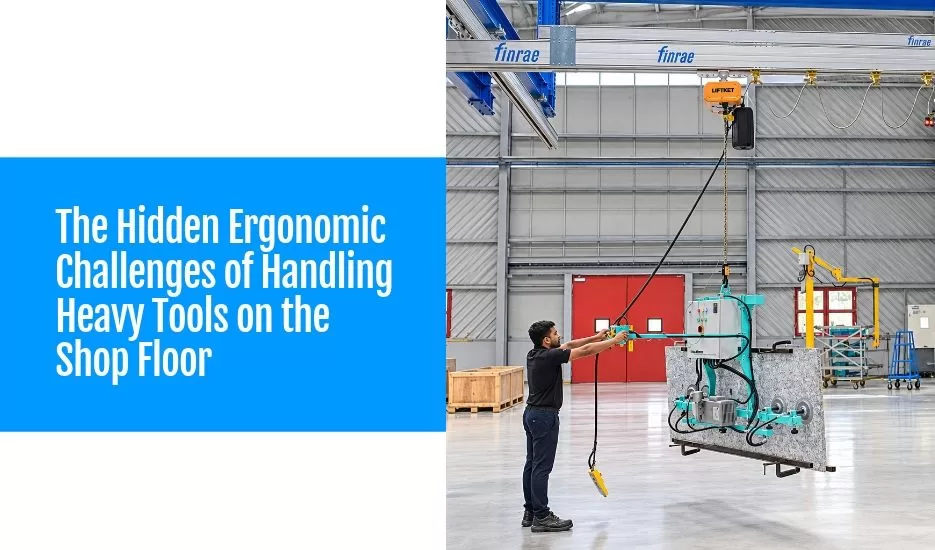
A tool support system carries or balances the equipment while allowing it to move within the required working area.
Depending on the application, this may involve a dedicated tool rail, an overhead crane arrangement or a compatible balancing device.
The operator can then guide the supported tool rather than carry its full weight throughout the operation.
For assembly applications, tool rails can be used with suitable trolleys to support tools such as nut runners and screwdrivers.
For larger equipment, an appropriately engineered aluminium crane system may be considered.
The selection depends on the tool, operating forces, required movement and workstation conditions.
The Importance of Smooth, Controlled Movement
Supporting the weight of a tool is only part of the solution.
The equipment must also move in a way that suits the operator's task.
Excessive travel resistance, poor positioning or an unsuitable movement path can make a supported tool difficult to handle.
This makes trolley selection, rail alignment and system configuration important design considerations.
Finrae's tool rail and aluminium crane system components are designed for use in industrial handling arrangements where guided movement is required.
Cables, Hoses and Workstation Organisation
Electrical and pneumatic tools often have cables or hoses connected to them.
These connections can interfere with movement if they are left unsupported or routed through the operator's working area.
Suitable cable-management components help organise the connections and accommodate their movement along the rail.
This contributes to a more organised handling arrangement and reduces unnecessary interference with the tool's travel.
Designing Around the Operator
Ergonomics should be considered when selecting both the tool and the system used to handle it.
Understanding the required movement, working height, operating forces and workstation layout helps identify opportunities to reduce unnecessary manual effort.
Finrae offers tool rails, aluminium crane systems and compatible components for different industrial handling requirements.
When selected and integrated appropriately, these systems can support easier tool movement and more practical workstation arrangements.
Looking to improve tool handling at your workstation? Explore Finrae's tool rail systems and discuss your application requirements with the team.