Aluminium vs Steel Crane Systems: Which Is Right for Your Facility?
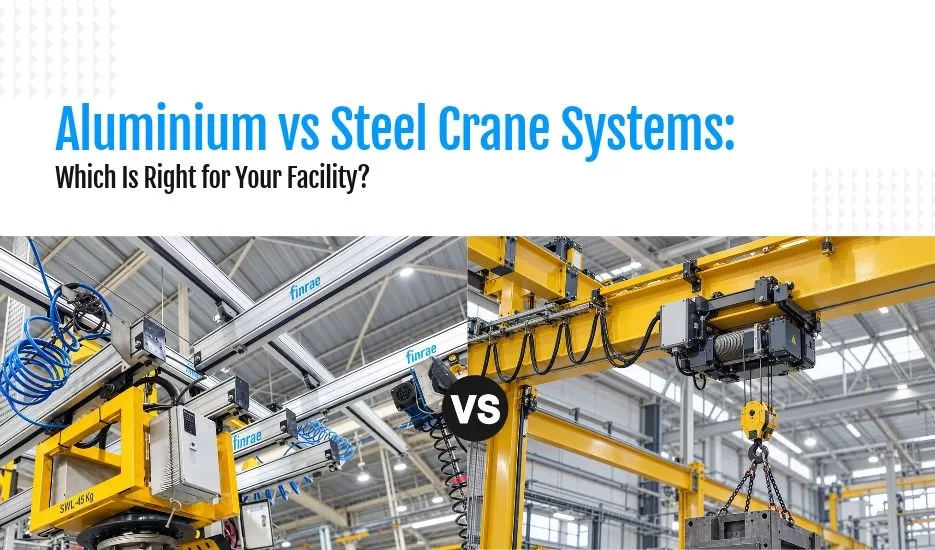
When a workshop or production line needs overhead material handling, the first decision is often the simplest one: aluminium or steel? Both can lift and move loads reliably, but they behave very differently once installed. This guide compares the two on the points that matter most in daily use.
1. Weight and the building structure
Aluminium has roughly one third the density of steel. A rail system made from aluminium crane profiles therefore puts far less dead load on the overhead structure, whether that is a building truss, I-beam or an existing support frame. In many plants this means a light aluminium system can be hung from existing steelwork without costly reinforcement, while a heavy steel crane may need new columns or runway beams.
2. Operator effort and ergonomics
A lighter moving structure takes less force to start, steer and stop. When a load is guided by hand, a low-friction aluminium rail with specialised trolleys lets operators position material accurately with little effort. That matters for ergonomics: reducing repeated pushing and pulling reduces fatigue and the risk of strain over a long shift. Systems such as the finrae Single Rail System are designed around smooth, noiseless trolley movement for exactly this reason.
3. Modularity and future changes
Production layouts change. A modular aluminium system is built from standard profiles, joint sets, suspensions and end caps, so it can be extended or re-arranged as the process evolves. You can start with one straight track and later add cross rails, a telescopic section or curved rails. Fabricated steel cranes are typically more fixed in their geometry.
4. Installation time and disruption
Lighter components are easier to lift into position and often need fewer people and less lifting equipment. That can shorten installation and commissioning, which helps when you cannot afford a long shutdown.
5. Where steel still makes sense
Very heavy lifting, long spans carrying large capacities and continuous heavy-duty cycles are the territory of conventional steel overhead cranes. If your loads run into many tonnes, steel is usually the right answer. For the wide range of routine and critical transfer tasks below that range, such as sheet metal, fixtures, tools, engine and body components and workstation handling, aluminium rail systems are often the more efficient choice.
A quick checklist
- Load and duty: What is the heaviest load, and how often is it moved?
- Structure: Can the building support the system without reinforcement?
- Flexibility: Will the layout change in the next few years?
- Operators: Is the load positioned by hand? How long are shifts?
- Integration: Do you need balancers, grippers or automation on the rail?
Next step
Not sure which side of the line your application falls on? Share your load, span and work area and our engineers will advise. Browse the finrae rail layouts or contact us for a recommendation.