Straight Lines Aren't Always Enough: Where Curved Rail Systems Make Sense
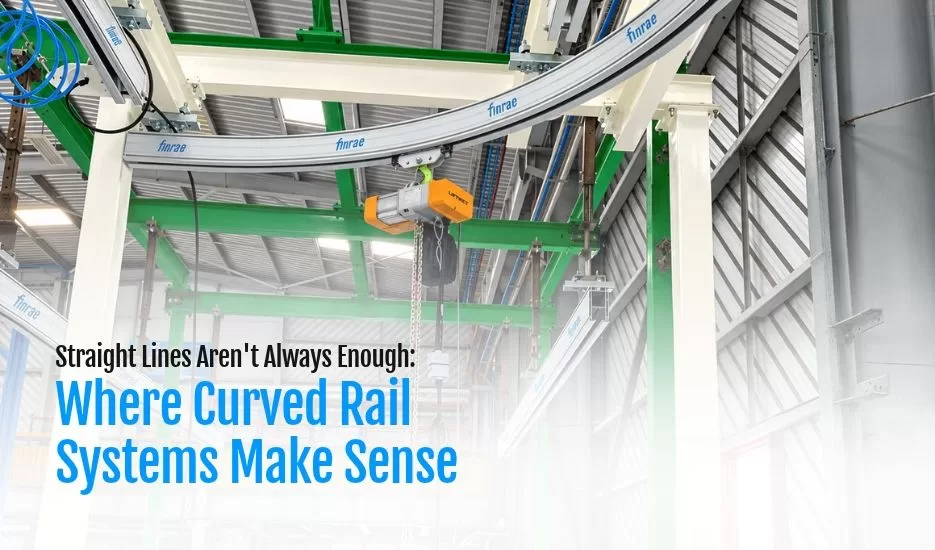
On paper, material moves from one workstation to the next in a straight line. On the shop floor, machines, columns, fixtures and work areas often get in the way. A straight rail can only follow a straight route.
What curved rails do
Finrae curved rails can be incorporated into aluminium rail systems to create routes that change direction. By connecting curved sections with straight rails, the handling arrangement can follow the movement path the application requires.
Where they make sense
- Around equipment: material needs to travel around a machine or structure.
- Between work areas: stations are in different orientations, so the route needs to turn.
- Flow-based layouts: L-shaped or looped production flows.
- Multi-station transfer: a continuous path linking several stations.
What to plan
The rail layout can be planned around the available space, the load and the transfer route. Think about where the route turns, which structures can carry the suspensions and what is being carried along the rail.
Same components throughout
Curved sections use the same family of profiles, trolleys and accessories as straight rails, so the system stays modular and can be extended later.
See it in practice
Read how the arrangement is used in curved rail transfer, or talk to our engineers about your route.